
XML to JSON Converter — Convert XML to JSON Free Online
Bridging Two Formats That Don't Naturally Speak to Each Other
XML and JSON both represent structured data — but in very different ways. Modern APIs default to JSON. Enterprise systems, legacy services, SOAP endpoints, and configuration files still use XML. When you need to work with both, converting between them manually is tedious and error-prone.
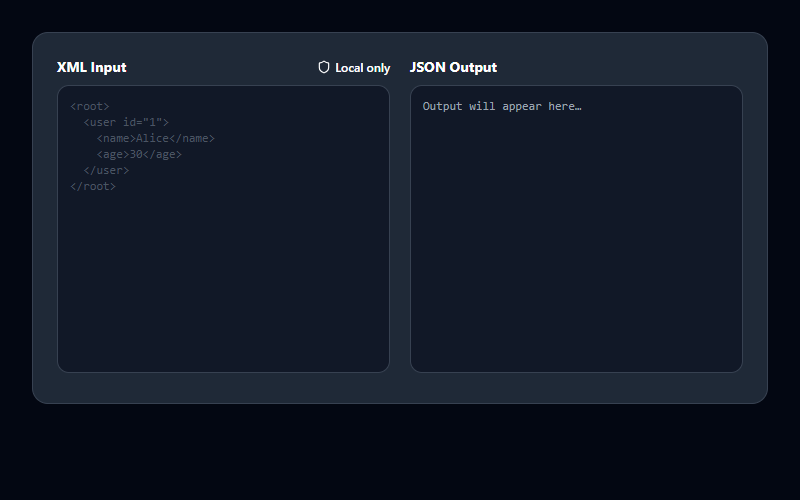
This tool converts XML to JSON and JSON to XML in your browser. Paste in one side, get the other side. Nothing is uploaded to any server.
Before and After
XML input:
<user>
  <id>1042</id>
  <name>Priya Sharma</name>
  <email>priya@example.com</email>
  <roles>
    <role>admin</role>
    <role>editor</role>
  </roles>
  <active>true</active>
</user>
JSON output:
{
  "user": {
    "id": "1042",
    "name": "Priya Sharma",
    "email": "priya@example.com",
    "roles": {
      "role": ["admin", "editor"]
    },
    "active": "true"
  }
}
How the Conversion Works
XML→JSON: An XML DOM parser reads the element tree. Each XML element becomes a JSON key. Text content becomes a string value. Multiple sibling elements with the same tag become a JSON array. Attributes can be mapped to prefixed keys (e.g., @id). The result is a JSON object mirroring the XML hierarchy.
JSON→XML: Each JSON key becomes an XML element tag. Nested objects produce nested elements. Arrays produce repeated elements with the same tag name. Primitive values become element text content.
Key conversion rules:
| XML | JSON equivalent |
|---|---|
Element <name>Priya</name> | "name": "Priya" |
Attribute <user id="1"> | "user": {"@id": "1"} |
| Multiple same-name elements | Array ["val1", "val2"] |
| Text + attributes mixed | {"#text": "...", "@attr": "..."} |
| Numeric text content | String in JSON (XML has no types) |
Where You Need This
Integrating with SOAP or legacy APIs: Older enterprise services output SOAP/XML responses. Converting to JSON lets you work with this data in modern JavaScript, Python, or Node.js environments without parsing XML manually.
Data migration: Moving data between systems — a CSV→XML export from an old system needs to become JSON for the new API. Convert incrementally or as a batch.
Config file formats: Some tools use XML configuration (Maven pom.xml, Spring XML config). Converting them to JSON for comparison or documentation purposes is faster with a converter than manual transcription.
API response comparison: When an API supports both XML and JSON response formats, compare them side by side to verify they represent identical data.
Webhook payload handling: Some services (older Salesforce, SalesForce, SAP, Stripe webhooks for certain events) send XML payloads that need to be translated to JSON before your backend processes them.
Limitations
Type information is lost from XML to JSON. XML has no native type system beyond strings. Numbers, booleans, and dates in XML text content all arrive as strings in JSON. You may need to post-process the converted data to convert "1042" to 1042 or "true" to true.
XML namespaces convert imperfectly. Namespace prefixes (e.g., <ns:user xmlns:ns="...">) may appear as literal characters in JSON keys. Complex namespace-heavy XML (WSDL, XSD, SOAP envelopes) may produce unwieldy JSON structures.
Self-closing tags and mixed content. <element /> and <element>text <child/> more text</element> (mixed content) have no clean JSON equivalent. The converter makes reasonable choices but complex mixed content may need manual cleanup.
JSON→XML tag names must be valid XML identifiers. JSON keys starting with numbers or containing special characters (@, -, spaces) can't become valid XML element names directly.
Related Developer Tools
- JSON Formatter — Format and validate the converted JSON output
- SQL Formatter — Format SQL alongside XML/JSON data work
- Base64 Encode/Decode — Decode base64-encoded XML or JSON from APIs
- Regex Tester — Extract data from XML strings when full conversion isn't needed
Recommended schema: SoftwareApplication + FAQPage