
Discount Calculator: Work Out Sale Prices in Seconds
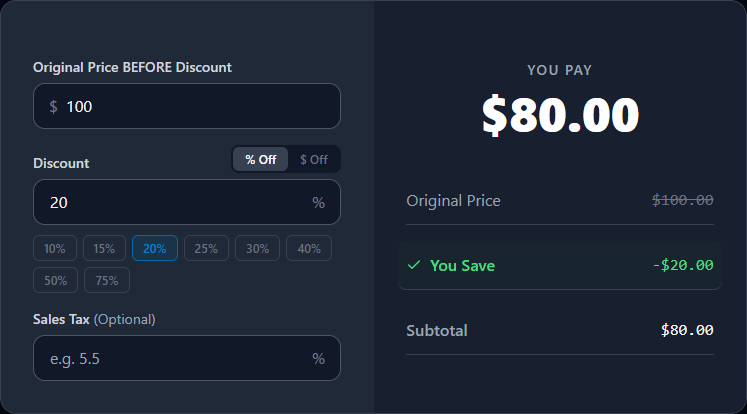
Three Ways to Calculate a Discount
Discount math comes up in a surprising number of situations — shopping, pricing, invoicing, tip splitting — and the calculation you need depends on what information you already have. Our calculator handles all three common scenarios in one place:
1. Original Price + Discount % → Final Price
The classic scenario. You see a $120 jacket on sale for 30% off. What do you pay?
Discount amount = $120 × 30% = $36
Final price = $120 − $36 = $84
Or as a single formula: Final = Original × (1 − Discount% ÷ 100)
2. Original Price + Final Price → Discount %
When you know both prices but want to know the saving. You bought a phone for $649 that was originally $899. What was the discount?
Discount% = ((899 − 649) ÷ 899) × 100 = 27.8%
This is useful for:
- Verifying that an advertised discount is accurate
- Comparing deals across different products
- Calculating the markdown percentage when repricing your own products
3. Final Price + Discount % → Original Price
Reverse-calculating the original price. A product is on sale for $75 after a 25% discount. What was the original price?
Original = Final ÷ (1 − Discount% ÷ 100)
Original = 75 ÷ 0.75 = $100
This trips a lot of people up. A common mistake is adding 25% back to $75 ($75 × 1.25 = $93.75) — but that gives the wrong answer because the 25% was taken off $100, not off $75.
When Discounts Stack: Multiple Percentage Offs
Retail promotions sometimes layer discounts: "40% off, plus an extra 20% off at checkout." This does NOT equal 60% off — and understanding why matters when comparing deals.
Two successive discounts are applied one at a time. On a $100 item:
- 40% off → $60
- 20% off the new price → $60 × 0.80 = $48
So the combined discount is 52%, not 60%. The formula for stacking two discounts:
Effective discount = 1 − (1 − D1) × (1 − D2)
= 1 − 0.6 × 0.8 = 1 − 0.48 = 52%
The more discounts you stack, the larger the gap between the "sum" and the "effective" discount gets. Our calculator handles stacked discounts automatically.
Tax + Discount: Getting the Order Right
In many countries, sales tax is applied after discounts. This is the most consumer-friendly arrangement (you pay tax on the reduced price). But sometimes a store applies tax first, then discount — which results in a slightly higher bill.
Standard order (tax after discount):
$100 item, 20% discount, 10% tax
→ $100 × 0.8 = $80 after discount
→ $80 × 1.1 = $88 final price
Reversed order (tax before discount):
$100 × 1.1 = $110 with tax
→ $110 × 0.8 = $88 final price
In this case the result happens to be the same (discount × tax is commutative when both are applied to the full price). But a fixed-amount discount ($20 off) combined with percentage tax breaks this symmetry.
Real-World Uses
Shopping smart: Quickly check if "30% off" on an already overpriced item is actually cheaper than a competitor's full price.
Freelance and invoicing: Apply an early payment discount or loyalty discount to an invoice total and verify the deduction is correct.
Retail pricing: If you run a shop, use the reverse calculation to confirm what your original price needs to be to offer a 40% discount and still hit your target sale price.
Salary negotiations: A percentage raise on a base salary, a percentage cut for contractor fees — the same math applies.
Coupon stacking: Calculate whether stacking a loyalty card discount, a promo code, and a sale makes a purchase genuinely worthwhile.
Understanding "X% Off" Marketing Language
Some advertised discounts are genuinely great. Others are built on inflated "original" prices that were never actually sold at that price. When you see a discount, useful questions to ask:
- Has this item actually been sold at the "original" price? Some retailers set an artificially high reference price specifically so they can advertise a large discount.
- Is the percentage discount applied to the item or to the order? "10% off orders over $100" is less valuable than "10% off every item."
- Does the discount require a minimum spend to unlock? You might spend more than you'd save.
None of this is to say discounts aren't real value — they absolutely can be. But the math is a tool, not a guarantee.
Related Search Queries
To help users find exactly what they are looking for, this tool is also optimized for searches like: sales calculator, calculate sales price, price sale calculator.