
Random Email Generator: Create Disposable Email Addresses
Two Different Needs, One Tool
People come to a random email generator for two distinct reasons:
-
Developers and testers who need realistic-looking email addresses for filling databases, testing registration flows, and validating email-related code — without using real people's information.
-
Regular users who need a throwaway email address to sign up for something that requires email verification, without exposing their real inbox to potential spam.
Our tool handles both use cases.
For Developers: Test Data That Looks Real
When building and testing a web application, you constantly need to populate databases with users, test registration forms, verify validation logic, and check how your system handles edge cases in email addresses.
Using real email addresses (even colleagues') for testing creates privacy problems. Making up random strings like aaa@bbb.com technically satisfies an email input field but doesn't test realistic scenarios — and won't pass strict email format validation.
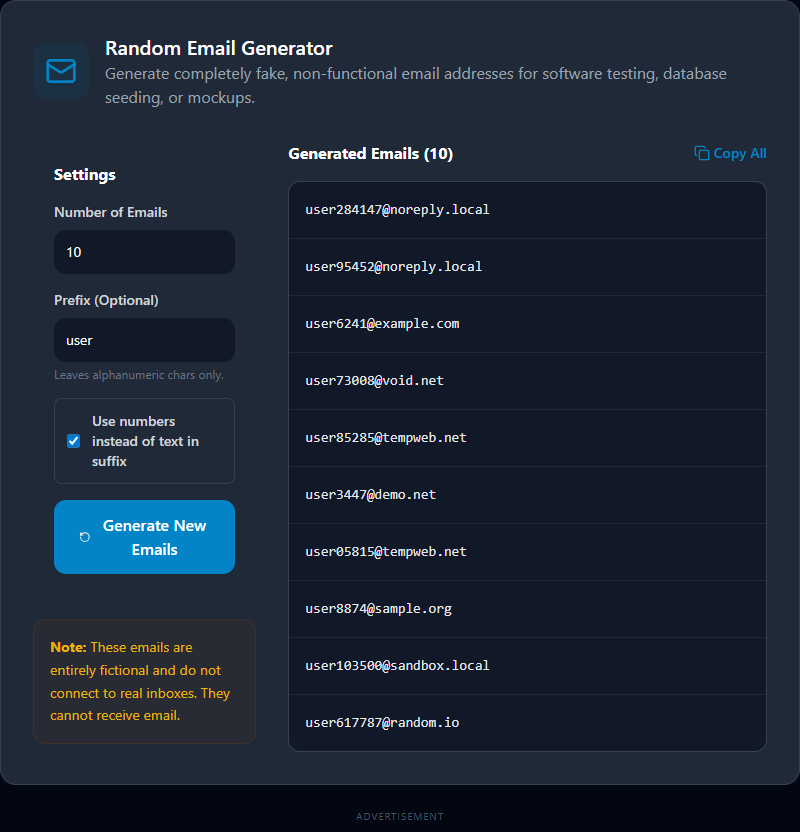
Our generator creates email addresses that:
- Follow realistic naming conventions (firstname.lastname, f.lastname, username123)
- Use realistic domain formats
- Include variety in structure (with and without dots, with and without numbers)
- Are generated client-side, so no data is sent anywhere
Batch generation: For database seeding and load testing, generate 10, 100, or 1,000 addresses at once and export as CSV or plain text.
For Users: Protect Your Real Inbox
Many websites require an email address just to access content, download a file, or use a free trial — but they're really collecting your email for marketing purposes. You'll agree to their terms, confirm your email, and spend the next six months unsubscribing from newsletters.
Disposable email services (also called "temp mail" or "guerrilla mail") give you a real, functioning email address that you can use to receive verification emails, then discard. Unlike our random email generator, disposable email services actually receive emails.
If you need to receive an email verification link, use a disposable email service. If you're testing a system or just need email addresses as data, our generator is what you want.
Popular disposable email services for when you need to actually receive mail:
- temp-mail.org
- guerrillamail.com
- mailnull.com
- 10minutemail.com
Email Address Format Rules
A valid email address (local-part@domain) must follow specific rules:
Valid local part characters:
- Letters (a-z, A-Z), digits (0-9)
- Dots (
.), hyphens (-), underscores (_) - Plus signs (
+) — useful for email filtering (yourname+spam@gmail.comroutes to your inbox but shows the alias that was given)
Invalid in most contexts:
- Two consecutive dots (
john..doe@gmail.comis technically allowed by RFC 5321 but rejected by most providers) - Starting or ending with a dot
- Special characters like
!,#,$outside of quoted strings
Domain part rules:
- Must include at least one dot
- No spaces
- TLD (the part after the last dot) can be multi-level (
.co.uk,.com.bd)
Our generator creates addresses that pass strict RFC 5322 format validation, so they're suitable for testing validators with various valid formats.
Common Testing Scenarios
Email uniqueness validation: Generate 100 email addresses and attempt to register all of them. Verify your system correctly rejects duplicates and accepts each unique address exactly once.
Format validation: Test your validation logic with edge cases — addresses with + tags, subdomains, long TLDs, very long local parts.
Email normalization: Some systems normalize emails by lowercasing, trimming whitespace, or stripping +tags. Test that your normalization works correctly.
Bulk user import: Testing a CSV import feature? Generate 500 email addresses in CSV format and verify your import pipeline handles them correctly.
Search and filter features: A database of realistic-looking email addresses is more useful than user1@test.com through user500@test.com when testing search behavior.
Privacy Note
All email addresses generated by this tool are created entirely in your browser. Nothing is sent to our servers. The addresses are randomly generated and not linked to real people or real mailboxes.