
Resume ATS Optimizer
Resume ATS Optimizer: How to Beat the Applicant Tracking System
Applying for jobs in the modern era feels remarkably like shouting into a void. You spend hours polishing your resume, hit "Submit" on a corporate portal, and are met with deafening silence—followed a month later by an automated rejection email.
If this sounds familiar, your resume likely wasn't rejected by a human hiring manager. It was rejected by a robot.
Over 98% of Fortune 500 companies use an Applicant Tracking System (ATS) to filter resumes before human eyes ever see them. Our Resume ATS Optimizer bridges the gap by acting as a 'mock ATS' right in your browser. By comparing your resume to the job description, it identifies the exact keywords you are missing, ensuring you pass the automated screen.
What is an Applicant Tracking System (ATS)?
An ATS is a complex software application that handles the recruitment process for companies. While its primary goal is managing the hiring pipeline, its most powerful (and ruthless) feature is its parsing engine.
When you submit a resume—whether as a PDF, Word document, or plain text—the ATS strips away all your beautiful formatting, columns, and design elements. It converts everything into raw text and drops it into a database.
How the ATS Ranks You
When a recruiter wants to fill a position, they don't read the 400 resumes in the database chronologically. Instead, they run a search query into the ATS using specific industry keywords, technical skills, and educational requirements derived from the job description.
The ATS algorithm ranks all the resumes based on:
- Keyword Presence: Does the resume contain the exact skills searched?
- Keyword Frequency: How many times do those skills appear?
- Contextual Years of Experience: Are those keywords associated with chronological work history?
If your resume scores below an arbitrary threshold—often matching fewer than 70% of the core keywords—you are automatically flagged as "unqualified" and filtered out.
Why Perfectly Qualified Candidates Fail the ATS
The single biggest mistake job seekers make is sending a "generic" resume to a dozen different employers.
Imagine you are a highly skilled software engineer applying for a role that lists "Proficiency in JavaScript" in the job description. However, on your resume, you listed your skills as: "Node.js, React, and ECMAScript".
To a human engineering manager, it is blatantly obvious that you know JavaScript based on those frameworks. To a rigid, keyword-driven ATS algorithm? It looks like a hard Fail. You didn't use the exact phonetic string JavaScript, so the machine assumes you lack the primary qualification.
You must meticulously mirror the terminology of the job description. If the posting says "Customer Success Specialist," do not apply with a resume titled "Client Support Manager."
How Our Free Optimizer Supercharges Your Resume
Tailoring your resume line-by-line for every single application is exhausting. Our Resume ATS Optimizer tool automates the heavy lifting while guaranteeing your absolute privacy.
100% Private, Client-Side Analysis
Many "resume review" websites are glorified data-harvesting engines that sell your employment history and contact information to third-party marketing brokers.
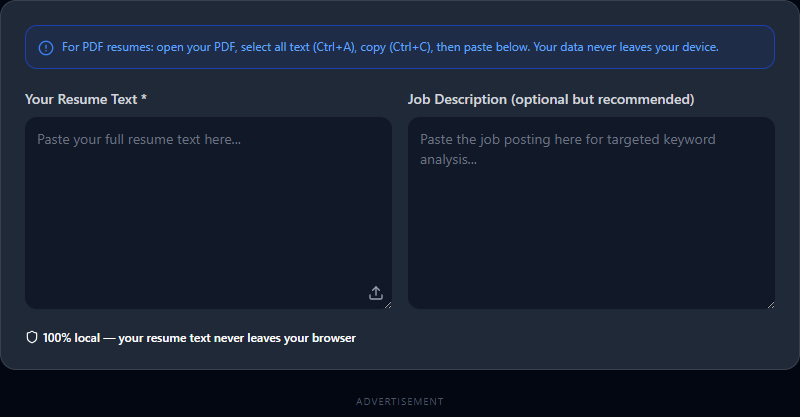
Our tool leverages modern JavaScript to execute complex text analysis entirely on your local machine. Your resume text and the job description never leave your browser window. There are no uploads, no databases, and no servers.
Using the Optimizer effectively
- Copy the Raw Text: Open your PDF or Word resume, select all text (
Ctrl+A), and paste it into the left column. - Paste the Job Description: Grab the entire job posting from LinkedIn, Indeed, or the corporate site and paste it into the right column.
- Analyze the Match Score: The tool strips out "stop words" (and, the, with) and cross-references the hard nouns and action verbs. You will receive an immediate percentage match score.
- Identify the Gaps: The most valuable output is the "Missing Keywords" list. The tool explicitly tells you which crucial terms exist in the job listing but are entirely absent from your resume.
- Implement Fixes: Weave those missing keywords naturally into your bullet points. Do not just "keyword stuff" them in a list at the bottom; integrate them into measurable achievements.
Final Advice for a Bulletproof Resume
While keywords guarantee you pass the robot, your resume still needs to impress the human manager who eventually reads it.
- Ditch Complex Formatting: Two-column layouts, graphics, and tables notoriously break ATS parsers. If the machine can't extract the text cleanly, you fail. Use a standard, single-column, text-based layout.
- Quantify Everything: Our tool checks for numerical data. Don't write "Increased sales." Write "Increased Q3 sales by 24% ($1.2M) exceeding the team quota."
- Export as PDF: Unless the application specifically demands a
.docxfile, always submit a standard PDF. PDFs perfectly lock your formatting and fonts in place, ensuring the human reviewer sees exactly what you intended them to see.