
Roman Numeral Converter: Numbers ↔ Roman Numerals Instantly
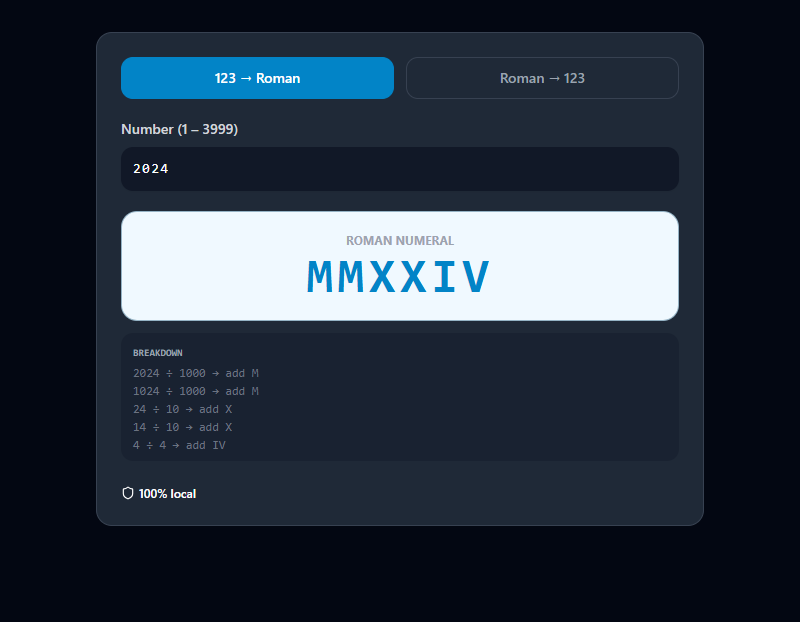
The Seven Symbols
Roman numerals use only seven distinct symbols, each with a fixed value:
| Symbol | Value |
|---|---|
| I | 1 |
| V | 5 |
| X | 10 |
| L | 50 |
| C | 100 |
| D | 500 |
| M | 1,000 |
Every number from 1 to 3,999 is expressed as a combination of these seven symbols, following specific addition and subtraction rules.
How Roman Numerals Work
Addition rule: When a symbol of equal or lesser value follows another, add the values.
III= 1 + 1 + 1 = 3VIII= 5 + 1 + 1 + 1 = 8XVII= 10 + 5 + 1 + 1 = 17
Subtraction rule: When a symbol of lesser value appears before a larger one, subtract it. Only six subtractive combinations are used in standard Roman numerals:
| Combination | Value | Instead of |
|---|---|---|
| IV | 4 | IIII |
| IX | 9 | VIIII |
| XL | 40 | XXXX |
| XC | 90 | LXXXX |
| CD | 400 | CCCC |
| CM | 900 | DCCCC |
Repetition limit: A symbol can repeat at most three times consecutively. That's why IV exists — you can't write IIII. The exception is I, X, C, M — V, L, D are never repeated.
Reading Examples Step by Step
MMXXVI (this very year, 2026):
- MM = 1000 + 1000 = 2000
- XX = 10 + 10 = 20
- VI = 5 + 1 = 6
- Total: 2026
MCMXCIX (1999 — Prince's famous song):
- M = 1000
- CM = 900 (1000 − 100)
- XC = 90 (100 − 10)
- IX = 9 (10 − 1)
- Total: 1999
CDXLVIII (448):
- CD = 400
- XL = 40
- VIII = 8
- Total: 448
Where Roman Numerals Still Appear
Roman numerals didn't disappear with the Roman Empire — they're still used in specific contexts where they convey tradition, formality, or clarity:
Movie sequels and franchises: Star Wars: Episode IV, Rocky IV, Super Bowl LVII. The roman numeral signals that this is part of an established, ongoing series.
Clock faces: Many analog clocks use Roman numerals. Interestingly, clock faces traditionally use IIII instead of IV for the 4 — possibly for visual balance, since the 8 (VIII) has three letters and symmetry looked better with IIII opposite it.
Book chapters and front matter: Page numbers in a book's introduction and preface are typically Roman (i, ii, iii, iv) in lowercase, keeping them visually distinct from the main numbered pages.
Monarchs and popes: King Charles III, Pope Francis the First (but Francis I in formal reference), Elizabeth II. When someone shares a name with predecessors, Roman numerals distinguish them.
Year of production: Film copyright notices (© MMXXVI), coin mintage years, building cornerstones, and architectural inscriptions often use Roman numerals for a classical feel.
Outlines: Legal documents, laws, and academic outlines use a mix of Roman numerals, letters, and Arabic numbers to indicate hierarchical levels (I. A. 1. a. i.).
Music theory: Chord progressions are labeled using Roman numerals where uppercase means major and lowercase means minor. The I–IV–V or I–V–vi–IV progression is described in Roman numerals regardless of what key you're in.
Limitations of Standard Roman Numerals
The standard Roman numeral system has a hard ceiling of 3,999 (MMMCMXCIX). Beyond that, ancient Romans used additional notation (like a bar over a symbol to multiply by 1,000), but these aren't standardized in modern usage.
There's also no zero in Roman numerals. The concept of zero as a number wasn't part of Roman mathematics — it came to Europe via Arabic numerals much later. This is one of the key reasons Arabic numerals replaced Roman numerals for almost all mathematical purposes.
Quick Reference: 1–100
| 1–10 | 11–20 | 21–30 | 40–100 |
|---|---|---|---|
| I, II, III, IV, V, VI, VII, VIII, IX, X | XI–XX | XXI–XXX | XL, L, LX, LXX, LXXX, XC, C |