
BMR Calculator: Find Your Basal Metabolic Rate
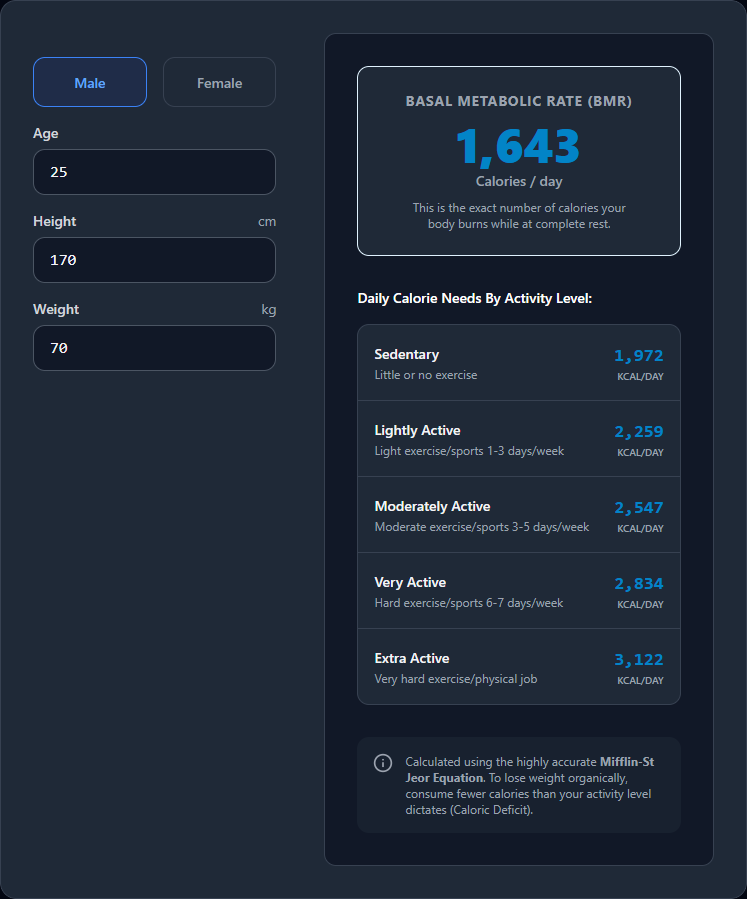
What Is Your BMR?
Your Basal Metabolic Rate (BMR) is the number of calories your body burns just to stay alive — breathing, circulating blood, repairing cells, maintaining body temperature — while you're completely at rest.
Think of it this way: if you lay in bed all day without moving, your BMR is the minimum number of calories you'd need to consume to not lose weight. It doesn't account for walking to the bathroom, making coffee, or any other activity. Pure resting energy expenditure.
Your BMR is determined primarily by four factors: your sex, age, height, and weight. Muscle tissue burns more calories than fat tissue, which is why two people with identical height and weight can have meaningfully different BMRs depending on their body composition.
The Formulas — Which One Are We Using?
There are several equations for estimating BMR. We support the two most widely used:
Mifflin-St Jeor (Our Default)
Developed in 1990 and considered the most accurate for most people:
| Formula | |
|---|---|
| Men | 10 × weight(kg) + 6.25 × height(cm) − 5 × age(years) + 5 |
| Women | 10 × weight(kg) + 6.25 × height(cm) − 5 × age(years) − 161 |
Harris-Benedict (Revised 1984)
An older formula, revised from the original 1919 version. Still widely cited but slightly less accurate for modern populations with more sedentary lifestyles:
| Formula | |
|---|---|
| Men | 88.362 + (13.397 × weight) + (4.799 × height) − (5.677 × age) |
| Women | 447.593 + (9.247 × weight) + (3.098 × height) − (4.330 × age) |
Both formulas are estimates. Individual results can vary by 10–15% due to genetics, hormonal differences, and body composition that the equations can't capture.
From BMR to TDEE: Your Full Daily Calorie Needs
BMR is just the starting point. To find how many calories you actually need each day, you multiply your BMR by an activity multiplier to get your Total Daily Energy Expenditure (TDEE):
| Activity Level | Description | Multiplier |
|---|---|---|
| Sedentary | Desk job, minimal exercise | BMR × 1.2 |
| Lightly active | Light exercise 1–3 days/week | BMR × 1.375 |
| Moderately active | Moderate exercise 3–5 days/week | BMR × 1.55 |
| Very active | Hard exercise 6–7 days/week | BMR × 1.725 |
| Extremely active | Physical job + heavy exercise daily | BMR × 1.9 |
Example:
- 30-year-old woman, 165 cm, 65 kg → BMR ≈ 1,441 calories
- With moderate activity (×1.55) → TDEE ≈ 2,234 calories/day
To lose weight gradually, she'd aim for roughly 1,734–1,984 calories (a 250–500 calorie deficit per day).
Why BMR Changes Over Time
Your BMR isn't a fixed number. Several factors shift it throughout your life:
Age: BMR tends to decline about 1–2% per decade after your mid-20s, mostly due to the gradual loss of muscle mass (sarcopenia). This is why many people find it harder to maintain their weight as they get older, even without changing their diet.
Muscle mass: A pound of muscle burns roughly 3× more calories at rest than a pound of fat. Resistance training that builds muscle raises your BMR — one of the most effective long-term strategies for weight management.
Dieting: Aggressive caloric restriction causes the body to adapt by reducing its metabolic rate — a phenomenon called adaptive thermogenesis. This is why strict diets often produce rapid initial results that then plateau. Gradual deficits paired with exercise minimize this adaptation.
Hormones: Thyroid hormones directly regulate metabolic rate. Both hypothyroidism (underactive thyroid) and hyperthyroidism (overactive) cause significant BMR changes — if your calculated numbers seem way off from your real experience, thyroid function is worth checking with a doctor.
How to Use Your BMR
For weight loss: Eat at your TDEE minus 300–500 calories per day. This creates a sustainable deficit of roughly 0.5–1 kg per week without triggering major metabolic adaptation.
For muscle gain: Eat at your TDEE plus 200–400 calories per day (a lean bulk). Too large a surplus adds fat; too small and you won't have enough energy for muscle synthesis.
For maintenance: Match your calorie intake to your TDEE. Monitor weekly average weight (weigh daily, take the average) and adjust as needed.
The calculator is a starting point, not a prescription. Real metabolisms vary. Use your BMR as a baseline, then adjust based on actual results over 3–4 weeks.